Advanced controls
The default settings work for an initial test. Use this page when you need a fresh proxy exit, more or fewer simultaneous browsers, a separate browser identity, or space back on the Railway volume.
Complete Set up Cloak Biz Scraper for your AI before changing these controls. Change one setting at a time and run a small read-only test afterward.
Rotate a profile's proxy exit
Each browser profile keeps a sticky residential proxy session. Rotate only after the current exit is clearly blocked or you deliberately need a new session.
In the dashboard:
- Close any browser currently using the profile.
- Open Settings → Profiles.
- On the intended profile, select New proxy session.
- Launch the profile again. The fresh exit applies on the next launch; it cannot change a browser that is already open.
The profile keeps its cookies, logins, fingerprint, name, country, and region. Only its sticky proxy session changes.
The equivalent AI prompt is:
Use the Cloak Biz Scraper MCP. Close only the blocked browser instance you created. Call
new_proxy_session(name="Default") once, then call create_instance(profile="Default",
geoip=true) and retry the page once. Report the result. Do not rotate repeatedly.
Repeated rotation and retrying can waste proxy traffic or worsen a site block. A new IP also does not bypass a login, CAPTCHA, paywall, or access rule.
Set the number and mix of browsers
Open Settings → Capacity. The two values divide the browser pool:
| Setting | Meaning |
|---|---|
| Most browsers at once | Maximum number the server admits at one time |
| Reserved for non-built-in tasks | Slots kept available for manually or AI-driven interactive browsers |
| Built-in task budget | Calculated as maximum minus reserve; used by sweeps and archives |
For example:
| Maximum | Reserved | Built-in tasks can use | When to choose it |
|---|---|---|---|
| 2 | 1 | 1 | Small host; one sweep while one interactive slot stays free |
| 4 | 1 | 3 | Balanced starting point for several sources |
| 4 | 2 | 2 | Two people or agents may browse while tasks run |
The reserve must be smaller than the maximum so built-in tasks retain at least one slot. Select Save and read any memory warning shown by the app.
Higher concurrency requires enough CloakBrowser sessions, proxy bandwidth, and Railway memory. A setting can be accepted while still being too large for the host. If browsers exit unexpectedly or the app warns about memory, lower the maximum before increasing host size. Start with one page per listing source and raise concurrency only after a stable run.
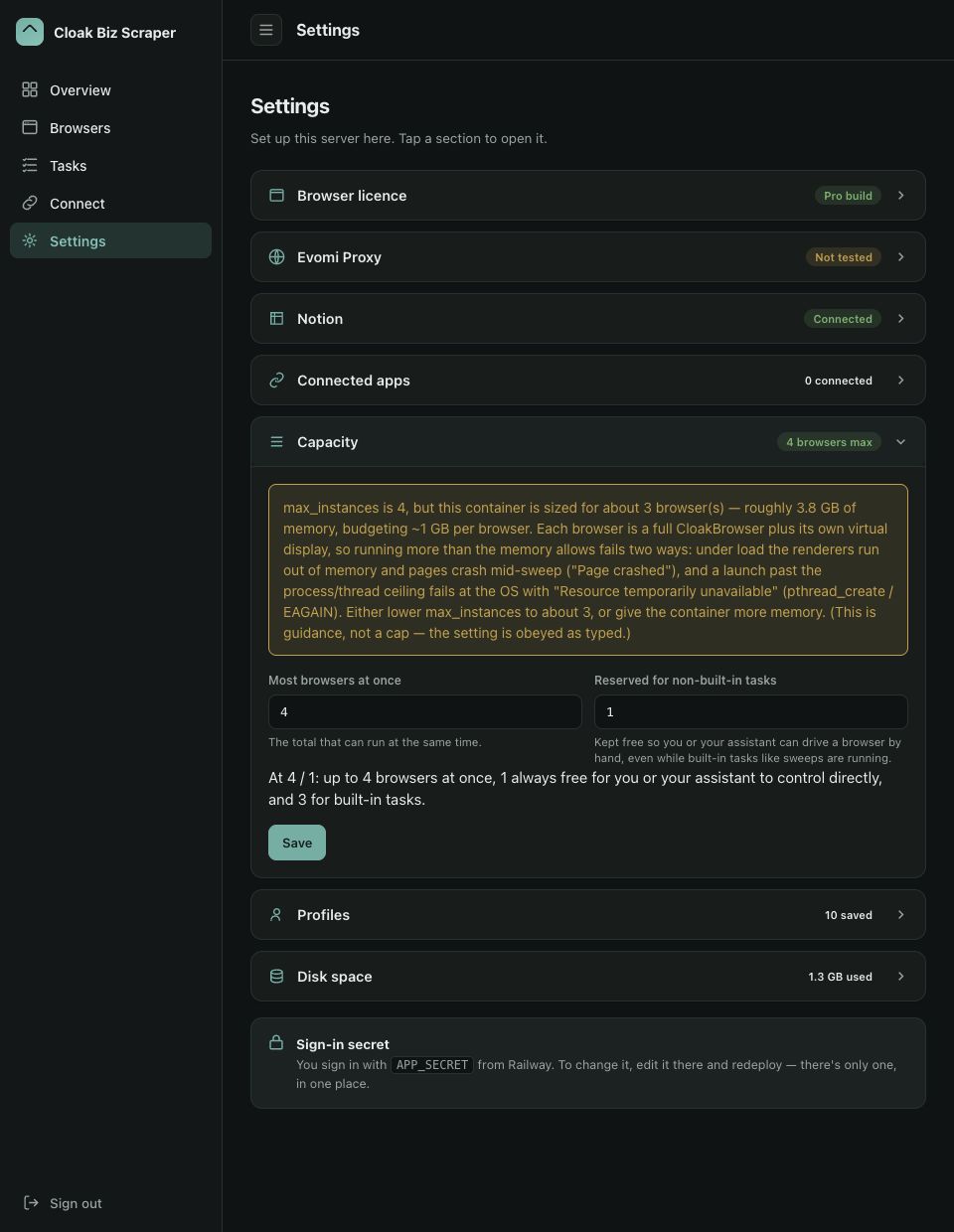
The screenshot shows development-server values and a real host-memory warning. Use the numbers and status reported by your own deployment.
Manage durable profiles
A profile is a saved browser identity. It keeps cookies, logins, local storage, fingerprint, and its own exit geography across browser relaunches.
- Use Default for ordinary continuity. It cannot be renamed or deleted.
- Select + New profile when you deliberately need a clean, separate identity.
- Edit changes a non-default name or future exit geography. Geography changes apply on the next launch.
- New proxy session changes the future exit IP while preserving saved browser data.
- Clear permanently erases cookies, logins, and cache but keeps the profile, location, and proxy session.
- Delete permanently removes a non-default profile and its saved data.
Close a profile's active browser before renaming, clearing, or deleting it. The Settings page shows saved data size for each profile so you can find unusually large identities.
An AI can use list_profiles, create_profile, update_profile, new_proxy_session, and
delete_profile. Make destructive intent explicit. For example, do not ask an agent to
“clean profiles”; name the profile and whether you mean rotate, clear, or delete.
Clean up the Railway volume
Open Settings → Disk space to inspect each category before deleting anything.
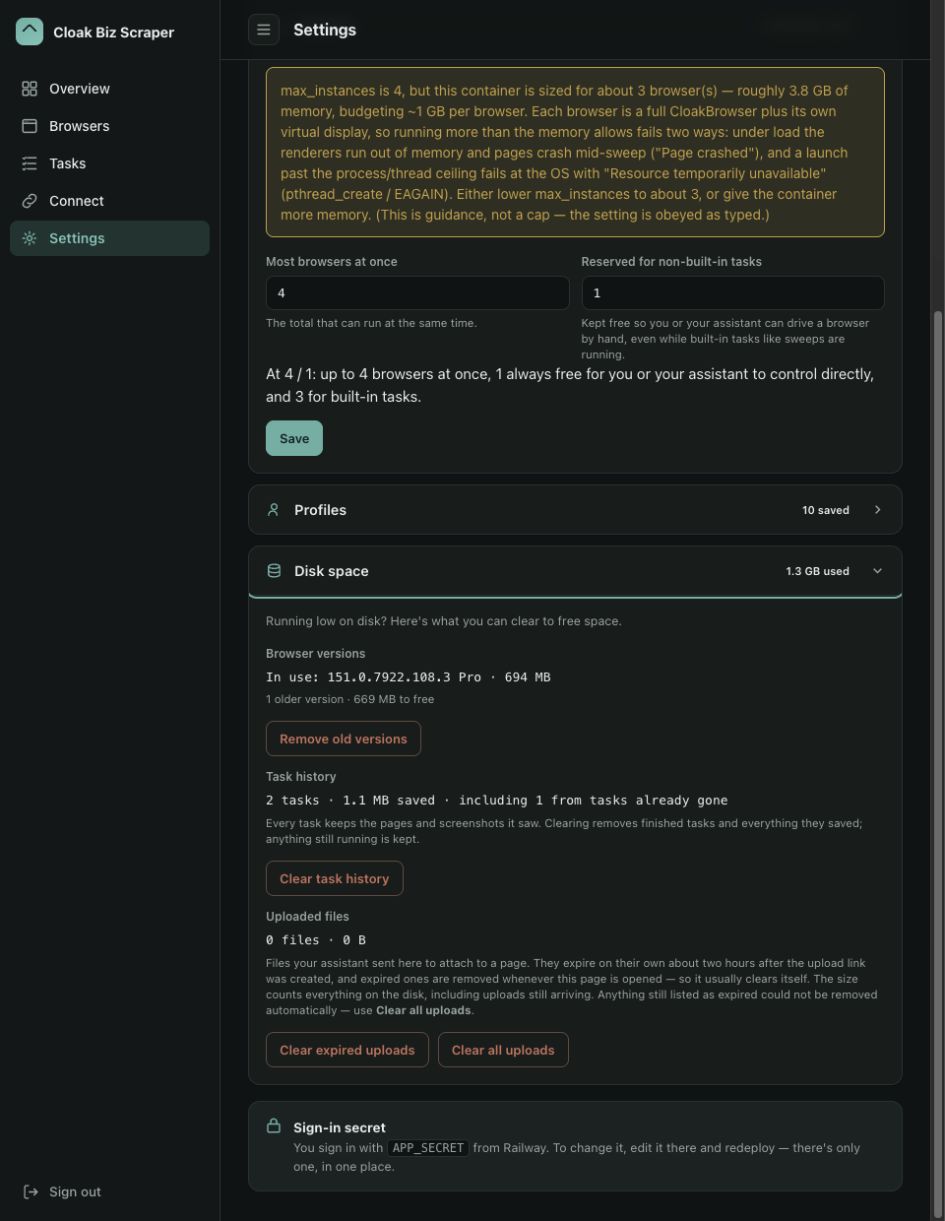
Browser versions
Select Remove old versions to delete older browser builds while keeping the one the server currently uses. If the app has not recorded the active build, open Browser licence, select Save & verify, then return to Disk space.
Task history
Every completed task can keep the pages and screenshots it saw. Clear task history permanently removes finished tasks and their evidence; a task still running is kept. Review failed runs before clearing because their screenshots and HTML are often the best diagnostic record.
Uploaded files
Uploads normally expire about two hours after their upload link was created, and the app tries to remove expired files when the Settings page opens.
- Clear expired uploads keeps files whose links are still live.
- Clear all uploads removes every uploaded file, including one an agent may still need.
These cleanup actions cannot be undone. Do not clear all uploads during an active task.
A conservative monthly maintenance routine
- Check Tasks → History and save any evidence you still need.
- Open Settings → Disk space and compare the three categories.
- Remove old browser versions.
- Clear task history only after the relevant failures have been reviewed.
- Clear expired uploads; use Clear all uploads only when no upload task is active.
- Review profile sizes and clear a profile only when you are willing to lose its cookies and logins.
- Run the read-only connection test from the scraper setup guide.